The Observer
Royal College of Art
graduation
Tate Gallery
degree show
Observer magazine
Observer magazine 2 June 1985
Educating Arty: Crisis in the Art Schools
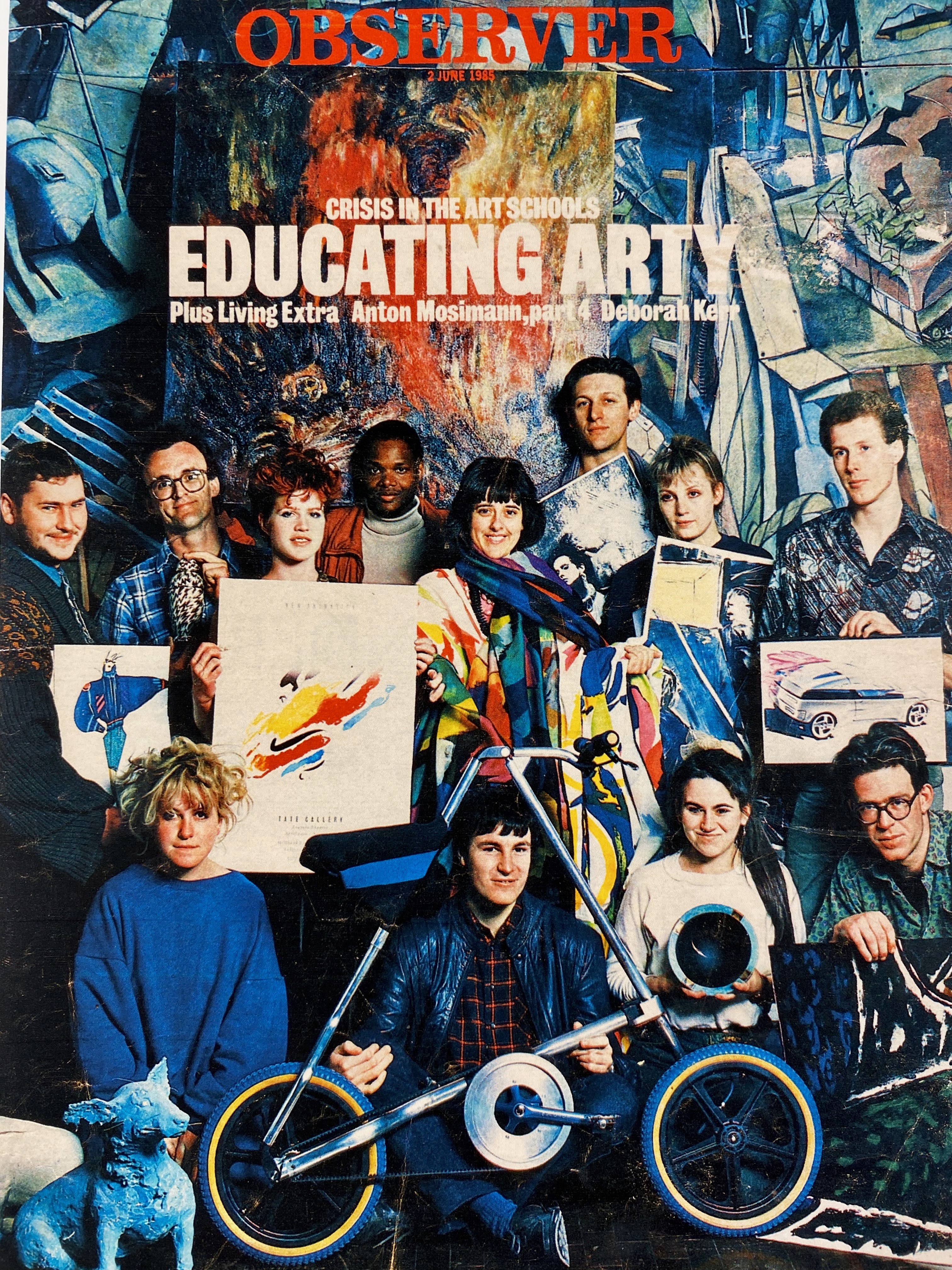
40 years ago, the Observer published this cover feature focussing on a ‘crisis’ in the UK’s art schools ("Educating Arty: Crisis in the Art Schools," The Observer, June 2, 1985, pp. 8-20). I was a student at the Royal College of Art (RCA) at the time and thought it would be interesting to reflect on this from today's perspective, just to see if anything has changed. (In the photo I’m third from left, holding a poster that I designed for a screening at the Tate based on my graduation film Carnival).
Jocelyn Stevens—saviour or ruthless bully?
The feature's focus is an interview by journalist Maureen Cleave with Jocelyn Stevens, RCA Rector from 1984 to the mid 1990's. Stevens was a former Fleet Street mogul with no background in culture, and perhaps because of this was personally appointed as Rector by then Prime Minister Margaret Thatcher, with a remit to make the RCA profitable. Stevens immediately reduced seventeen departments to four, axed many courses, and slashed the MA course length for students from three years to two. He defends this in the interview by asserting that the RCA's very survival was in question, and that he was basically its saviour.
Stevens' obituary (Stephen Bates, The Guardian, October 14, 2011) paints him as “Ruthless… revelling in a reputation for brusqueness and bullying,” famous for screaming rages (including firing someone over an intercom then throwing a filing cabinet at them out of a fourth-floor window), and Stalinist purges of academic staff.
Many students and staff I knew back then hated the Stevens regime, and believed his appointment was a political message to all art schools, i.e. 'do what you are told, or else.' Dick Ross, head of department in the School of Film and Television where I was studying, was made from similar cloth. On our first day as film students, Ross gave a lecture bemoaning the "silent Marxist films" previous students had made. He told us that at the RCA we were to make only commercially viable films, in colour, with sound and conventional narratives. All students who disobeyed risked having their funding removed. Whilst making Carnival I was personally criticised for animating on small pieces of paper. I was instructed to switch to using larger industry-compliant pieces of paper, and to move my peg bar (the tool that registers each animation frame), from the top of the page to the bottom. I found these directives ridiculous, stuck to my guns regarding small pieces of paper, and avoided further conflict by hiding out in my flat, where I animated the remainder of Carnival and created its soundtrack.
I was right to stick to my guns. Carnival was a groundbreaking film, due partly to how those small bits of paper magnified the dramatic effect of my abstracted ink brushstrokes and bright blocks of oil pastels, and the film's lyricism and fluidity made it hugely attractive to commissioners of commercials, title sequences, and music videos in the 1980's.
Much of my commissioned work evolved from Carnival, but twelve years on from this cover article my career ended catastrophically. Elsewhere on this website I describe how my ex-husband attempted to murder me in 1996 (which caused me to develop post-traumatic stress disorder), and how a few months later in 1997 I then developed an overwork-related hand injury (task specific dystonia), which ended my career overnight. As a consequence I had a mental breakdown, entered the UK mental health system, and endured further traumas within it, for many years.
In my recent (2023) PhD Bearing Witness: Autoethnographic Animation and the Metabolism of Trauma, I explore some of these experiences and investigate how animation about autoethnographic (lived) experience can help survivors process trauma.
The RCA today
I decided to return to the RCA to study for my PhD partly to exorcise the negative feelings I'd had about the college after completing my Masters there. I was pleased to find that in comparison to the 1980's, today's MA students have greater academic, technical, and pastoral support, and for sure they are at less risk from flying filing cabinets. But because courses have now been slashed to one year's length, I do worry that they may not have enough time to make necessary mistakes, and experiment, and develop technical skills. In the 1980's I was lucky to have three luxurious years to complete my MA, which enabled me to try out different animation styles, and make several other films before I found my own unique voice with Carnival.
And I am grateful also that back in 1985 the neoliberal hive-mind had not entirely hijacked society. To counter Stevens' interview in the Observer article, artist Richard Hamilton (p. 15) puts forward the case for artists to be paid simply to be artists, and critic William Feaver argues against the creation of art school monocultures (p 8). Given the 21st century's hyper-commodified society and the rise of AI, their opinions (below) are if anything more relevant in 2025 than they were forty years ago. Today's students are facing increasingly intransigent challenges, but I do hope that they find creative ways to thrive.
“The art schools should be seen as places where civilised behaviour can be taught better than anywhere else. As more people become unemployed, the more of them that become artists the better. As soon as students finish their course, the government should put them on a pension.” Artist Richard Hamilton
“Art schools are falling into the trout farm category. They are being streamlined and systemised. Their virtues are being flushed away… What’s happening to some of our art schools now is akin to prairie farming; the grubbing out of seemingly unproductive hedgerows to create uninterrupted acreages of rape.” Art critic William Feaver
Related articles
Reflections on Jimi Hendrix “Fire”
+ Read more
Royal College of Art
graduation
Tate Gallery
degree show
Observer magazine
Animation at the Biennale
+ Read more
Royal College of Art
graduation
Tate Gallery
degree show
Observer magazine
Attempted murder and Levis: Variations on a Theme
+ Read more
Royal College of Art
graduation
Tate Gallery
degree show
Observer magazine